One of the classes I get to teach every few years is a course on the Salem Witch Trials, which I really enjoy because it allows us to spend a whole semester really digging into one historical event from a lot of different perspectives and historical interpretations. There are many fascinating people associated with the trials, and one that always catches my attention is George Burroughs, because he doesn’t match the typical profile of a suspected witch yet he was still executed, even though he was living about a hundred miles away when the trials began. Today I’m sharing a short biography of him.
George Burroughs was the second minister to serve in Salem Village’s church. He was from a wealthy family in Suffolk County, England, and he seems to have grown up in Roxbury, Massachusetts, though it’s not known when his family moved to America. After he graduated Harvard University in 1670 at 18 years old, he became a minister in Falmouth, Maine. The community disbanded following Indian attacks during King Philip’s War, causing Burroughs to move back to Salisbury, Massachusetts. He was appointed minister of Salem Village’s parish a
few years later in 1680. Though he initially took the parish with the intention of mediating an ongoing town feud, he had a troubled tenure as minister; by 1683, he had stopped meeting his congregation and prepared to move back to Maine amidst arguments and discontent with his congregation over his salary and other matters. He was even arrested for debt in May 1683 before he left Salem for Maine.
On April 21, 1692, Abigail Williams accused Burroughs of not only being a witch, but of masterminding the entire witch outbreak. Court officials went to Wells, Maine to bring him back as a prisoner to face trial in May 1692. Burroughs was jailed in Boston during most of May-July, 1692, finally coming to indictment and trial on August 12. Nearly all of the afflicted girls accused Burroughs, fainting when seeing
him in court. Witnesses from Maine and Salem alike came to testify to Burroughs’ leading role in the witch crisis. A short but physically powerful man, Burroughs had survived Indian attacks and life on the frontier in Maine, and was well known for his boasts, intimidating stares, and feats of great physical strength, like carrying a whole barrel of cider over his head and lifting a ten pound flintlock with one finger. These characteristics were all presented as evidence of his involvement with the supernatural, as were criticisms that he had not baptized his youngest children or even attended church for some time. Many scholars today believe he had become a Baptist.
Most convincing to the judges in his case was the testimony of Ann Putnam, Jr. and Mercy Lewis. Ann claimed that the specters of Burroughs’ two deceased wives visited her and told how he had murdered them. Young Ann’s accusations mirrored those of his second wife’s family, who believed that more than the harsh Maine
climate had contributed to their relative’s death. Mercy Lewis, who had briefly lived with the Burroughs family when her own parents died in an Indian attack in 1689, provided the most detailed evidence of Burroughs’ witchcraft, stating that he tried to trick her into signing the devil’s book and a few days later, carried her to a high mountain, showed her all the kingdoms of the world, and promised her wealth and power if she wrote in his book; if she refused, he would throw her off the mountain and break her neck (echoing the devil’s temptation of Christ in Matthew 4:8). The entire Putnam family (except Joseph Putnam) joined in depositions against Burroughs, saying they believed the girls’ testimony.
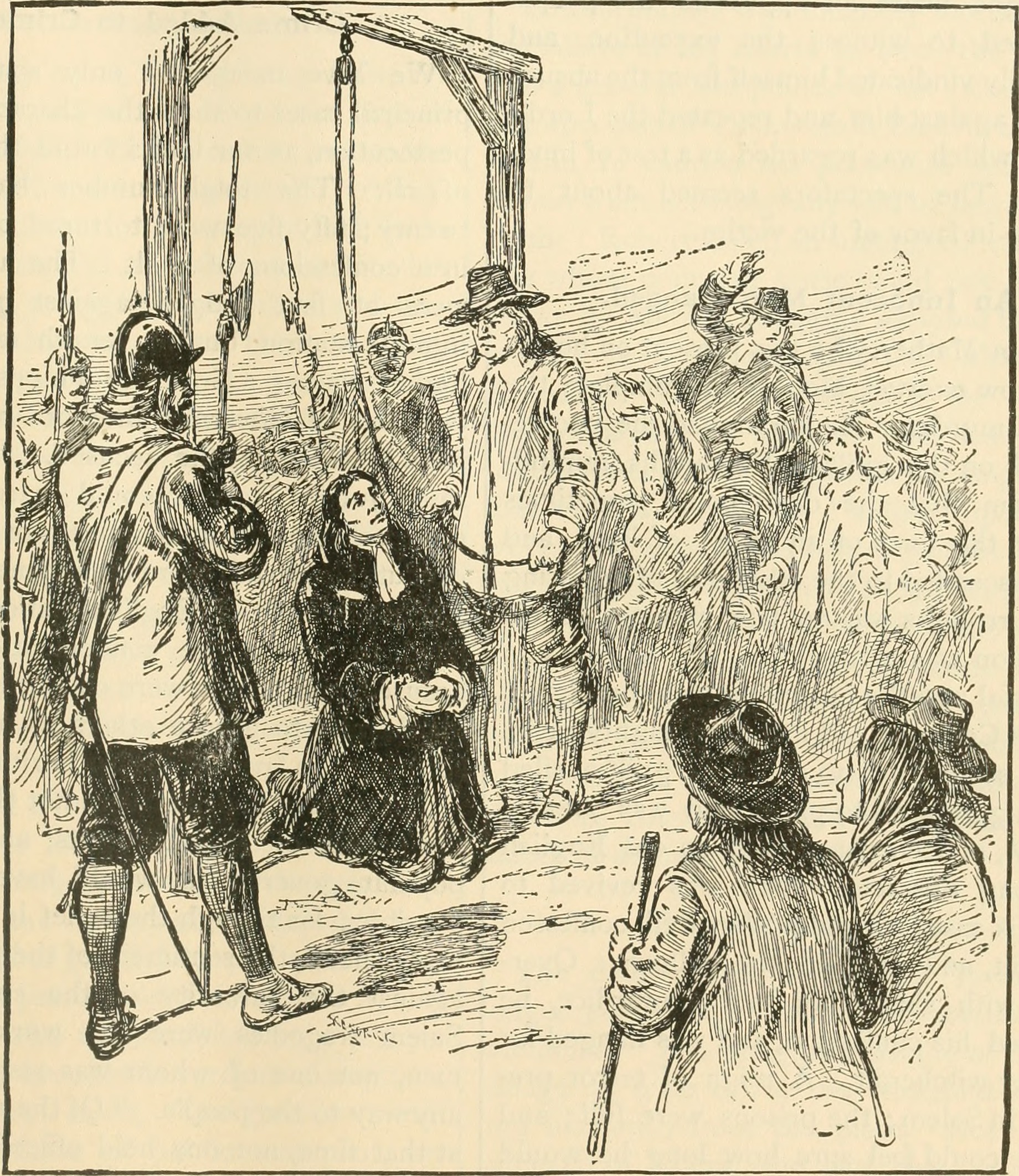
On August 19, 1692, George Burroughs went to the gallows protesting his innocence and reciting the Lord’s Prayer. Folklore stated that witches were unable to pray the words of Christ, so Burroughs’ prayer unsettled the crowd. Reverend Cotton Mather was instrumental in ensuring that the sentence given in court be carried out. The day after his execution, an accuser and confessed witch, Margaret Jacobs, recanted her testimony, writing to the judges that she had lied and Burroughs and her own grandfather, George Jacobs, Sr., were dead as a result. She claimed to be afraid of the afflicted girls and deeply regretted giving false evidence in order to save her own life and liberty. Her recanting, as well as that of other confessed witches, gave Mather and other Puritan ministers pause and eventually helped bring an end to the trials. George Burroughs’ children, though, were still filing petitions into the 1750s to try to clear his name and restore his property.
Sources used:
- Paul Boyer and Stephen Nissenbaum, Salem Possessed: The Social Origins of Witchcraft (New York: MJF Books, 1974), xvii, 6, 8, 12-13, 17, 32, 54-56.
- Peter Charles Hoffer, The Salem Witchtrials: A Legal History (Lawrence: University Press of Kansas, 1997), 109, 113-119, 136.
- Carol Karlsen, The Devil in the Shape of a Woman: Witchcraft in Colonial New England (New York: W.W. Norton & Co., 1998), 38, 49, 241, 245-246.
For some primary documents that focus on the trial of George Burroughs, see the collection of case files about George Burroughs at The Salem Witch Trials Documentary Archive Transcription Project.