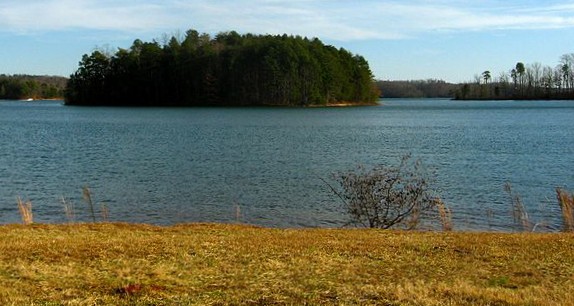
Fort Prince George was built across the river from the prominent Lower Cherokee town of Keowee in 1753. Today, both sites lay about 150 feet under Lake Keowee in upstate South Carolina.
The fort ultimately cost £5,000.1 Lower Cherokees donated the land, seeing the advantages of having a fort nearby, especially for trading purposes. Fort Prince George’s location was dictated by its Cherokee hosts, and militarily, it was a horrible location–surrounded by mountains on three sides, it would be difficult to defend if subjected to a serious attack.2 Fort Prince George was also shoddily constructed; built in only 22 days, it needed almost constant renovations and repairs. At one point in 1757, the Keowee River had so eroded the fort’s walls that visiting Colonel Henry Bouquet noted the walls were walling down, and the “defensible” ditch (meant to be 5 feet wide and 12 feet deep) could be easily leaped over by a small child. The gunpowder was stored in a small log building that appeared to be “incapable of resisting the least shower of Rain.”3
The fort was roughly 100 feet square, with diamond shaped bastions in each corner. The garrison’s size ranged from 14-130 men. The site was largely deforested, as Cherokees at Keowee had long used it as farmland, so timber was in short supply, contributing to the exterior walls being made of dirt and thus needing repair after every heavy rain.4
From 1753-1759, Lachlan Shaw and Lachlan McIntosh seem to have taken turns as commanders of Fort Prince George. Both men had strong family connections to the Indian trade. Lieutenant Richard Coytmore, who had formerly been stationed at Fort Loudoun took over in April 1759 and appears to have been a deeply flawed leader. He was routinely accused by Cherokee leaders (as well as other colonists) of antagonizing relations with Keowee. In the most troubling of these accusations, he and two other soldiers were implicated in the rape of several Cherokee women.5
During the Anglo-Cherokee War, Fort Prince George played a pivotal role in negotiations, holding prisoners, and staging assaults on Cherokee territory. Governor William Henry Lyttelton moved “negotiations” with Cherokee leaders, whom he had taken prisoner in Charlestown, to Fort Prince George in December 1759. Twenty-two of these men remained as hostages after Lyttelton’s treaty, waiting to be exchanged for the two dozen “murderers” the governor demanded by handed over to colonial justice. Oconostota then attacked the fort, killing Coytmore outside the fort after he had lured the unpopular commander outside on pretense of needing an escort to Charlestown. The garrison retreated into the fort and killed the remaining 17 hostages (five had died in the weeks before, most of them from smallpox).6 Second-in-command Alexander Miln later claimed that the hostages had hidden weapons, and the soldiers acted in self-defense. In his report a week later, Miln concluded:
With that the Men immediately fired on them and fell to work, but before I could get one to hear or answer me they laid them all lifeless, and happy for us all that they were destroyed, for searching the House where they were kept found a Bottle of Poison, that they had hid under Ground, which we imagined was to poison the Well.
Alexander Miln to William Henry Lyttelton, 24 February 1760, Documents Relating to Indian Affairs, 1754-1765, volume II, edited by William L. McDowell, Jr. (Columbia, SC: University of South Carolina Press, 1970), 500.
After the deaths of the hostages, Fort Prince George served as a staging ground for attacks on Cherokee towns. In summer 1760, Archibald Montgomery led attacks on Lower Cherokees towns. In summer 1761, Major James Grant led attacks on Middle Cherokee towns and conducted negotiations with Cherokee leaders into the fall.
Fort Prince George remained as a colonial fortification until its abandonment in 1768.
- Terry W. Lipscomb, editor. The Journal of the Commons House of Assembly: October 6, 1757-January 24, 1761, volume 15 (Columbia, SC: South Carolina Department of Archives and History, 1996), xvi. ↩︎
- Bryan Forrest McKown, “Fort Prince George and the Cherokee-South Carolina Frontier, 1753-1768” (M.A. Thesis, Clemson University, 1988), 4, 22, 73. ↩︎
- 13 July 1757, Henry Bouquet to Robert Napier, The Papers of Henry Bouquet, 1: 138. ↩︎
- Bryan Forrest McKown, “Fort Prince George and the Cherokee-South Carolina Frontier, 1753-1768” (M.A. Thesis, Clemson University, 1988), 19, 23-24; Marshall W. Williams, “Fort Prince George, South Carolina,” in The Archaeology of French and Indian War Frontier Forts, edited by Lawrence E. Babits and Stephanie Gandulla (Gainesville, FL: University Press of Florida, 2013), 60-61. ↩︎
- Paul Demere to William Henry Lyttelton, 20 May 1758, “William Henry Lyttelton Papers” (Clements Library, University of Michigan, Ann Arbor), correspondence box 7; John Richard Alden, John Stuart and the Southern Colonial Frontier: A Study of Indian Relations, War, Trade, and Land Problems in the Southern Wilderness, 1754-1775 (Ann Arbor, MI: University of Michigan Press, 1944), 82; James Adair, The History of the American Indians, Particularly Those Nations Adjoining to the Mississippi East and West Florida, Georgia, South and North Carolina, and Virginia (New York: Johnson Reprint Corporation, 1968), 246. ↩︎
- Alexander Miln to William Henry Lyttelton, 24 February 1760, Documents Relating to Indian Affairs, 1754-1765, volume II, edited by William L. McDowell, Jr. (Columbia, SC: University of South Carolina Press, 1970), 497-501. ↩︎