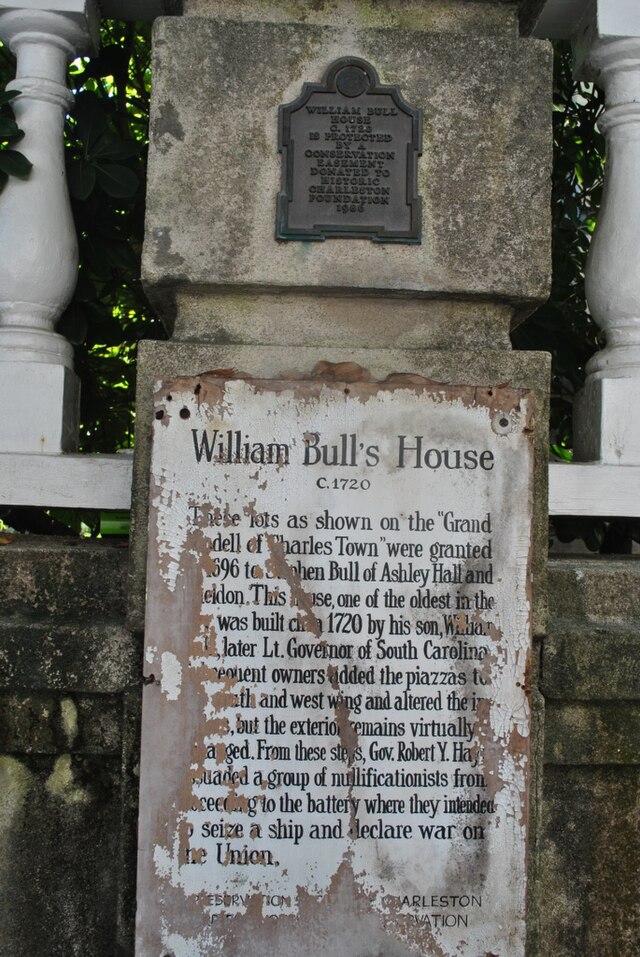
William Bull (September 24, 1710-July 4, 1791) was arguably the most important South Carolina-born politician during the Anglo-Cherokee War. He was born at Ashley Hall Plantation, one of the oldest colonial settlements along the Ashley River in South Carolina, and was educated in London before he received an M.D. at Leyden University in the Netherlands. He was the first American-born person to earn an M.D. but never practiced medicine. Instead, he followed in his father’s footsteps in South Carolina politics.
Bull served in the South Carolina Commons House of Assembly from 1736-1749. He briefly served as Speaker of the House, as his father had, and like his father became a member of the Royal Governor’s Council in 1749. He became president of the Council and Lt. Governor in 1759 (another office his father had held), serving under William Henry Lyttelton during the beginning phases of the Anglo-Cherokee War. The elder Bull had served as acting governor form November 1737-December 1743, before James Glen’s arrival. Bull II continued in that role until 1775, serving as acting governor a total of 5 times spanning 8 years. It was Bull who oversaw the majority of the Anglo-Cherokee War—a war he had opposed—including the arrivals of the Highland Regiments led by Archibald Montgomery and James Grant in summers 1760 and 1761 and the negotiation of the end of the war. The peace treaty Bull negotiated notably arranged for the return of Cherokee and colonial prisoners and delineated a new boundary line that cut into Lower Cherokee towns’ hunting grounds. Bull tempered demands for Cherokee punishment coming especially from his peers in the Commons, who urged Bull that “nothing but the severest Chastisement will ever procure from that perfidious People a firm & honourable Peace.”[1]
Bull stepped back into his lieutenant governor role upon Thomas Boone’s arrival but moved in and out of the acting governor role over the next decade. He supported the expansion of South Carolina colonists into the backcountry, enforced increasingly unpopular royal taxes like the Stamp Act, and found himself increasingly at odds with more revolutionary colonial politicians. He resigned from the Royal Council in 1775 and returned to Ashley Hall. He was banished from South Carolina in 1777 after refusing to take a loyalty oath to the new state and left for England, returning after Charlestown’s capture in 1780. His property was eventually confiscated for his loyalty to England, and he returned to England permanently in late 1782, where he died in London in 1791.
| Predecessor | Start Date | End Date | Replaced By |
|---|---|---|---|
| William Henry Lyttelton | April 1760 | December 1761 | Thomas Boone |
| Thomas Boone | May 1764 | June 1766 | Charles Greville Montagu |
| Charles Greville Montagu | May 1768 | October 1768 | Charles Greville Montagu |
| Charles Greville Montagu | July 1769 | September 1771 | Charles Greville Montagu |
| Charles Greville Montagu | March 1773 | June 1775 | William Campbell |
[1] 11 October 1760, The Journal of the Commons House of Assembly, Volume 15, edited by Terry W. Lipscomb (Columbia, SC: South Carolina Department of Archives and History, 1996): 767, 771.
Sources:
J. H. Easterby, ed., The Journal of the Commons House of Assembly: March 28, 1749-March 19, 1750, vol. 9 (Columbia, SC: South Carolina Archives Department, 1962), xii.
Jack P. Greene, The Quest for Power: The Lower Houses of Assembly in the Southern Royal Colonies, 1689-1776 (Chapel Hill, NC: Institute of Early American History and Culture and University of North Carolina Press, 1963), 32-33, 35.
Alexander Moore, “Bull, William II.” South Carolina Encyclopedia (University of South Carolina, Institute for Southern Studies, 2022), https://www.scencyclopedia.org/sce/entries/bull-william-ii/