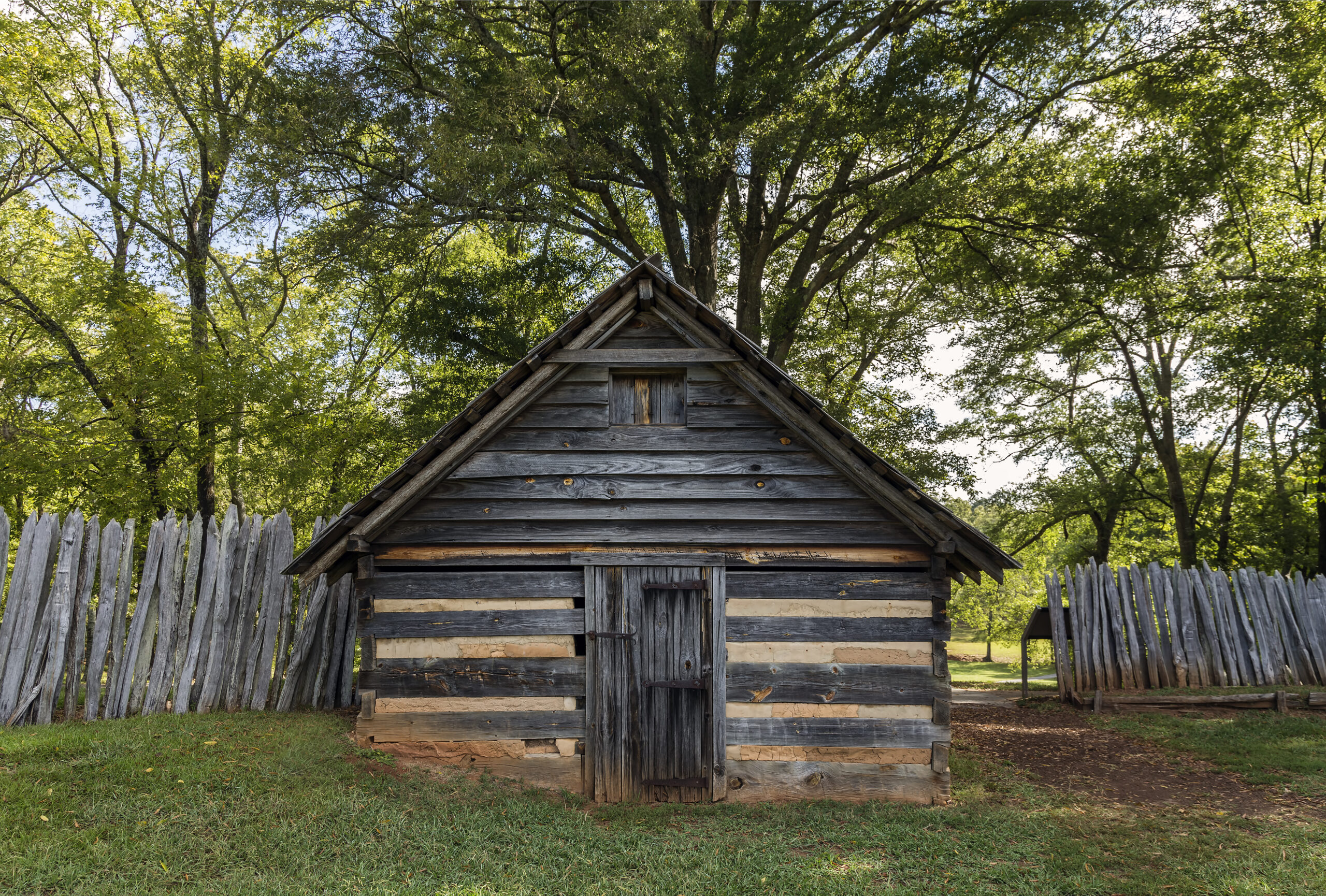
Ninety Six reportedly got its name from its geographic location, being roughly ninety-six miles southeast from the Lower Cherokee town of Keowee (it is about 170 miles from Charleston). It was one of the westernmost Carolinian settlements during the Anglo-Cherokee War.
Native American habitation around Ninety-Six dates back to at least 9000 BC. The oldest artifact found at the site was a Clovis projectile point, a rarity in South Carolina archaeology. By the time British colonists were living in South Carolina, the Cherokees were the dominant group in the region. References to “Ninety Six” start appearing in South Carolina records in the 1730s. The area became increasingly important in the 1740s, when Governor James Glen held a conference with Cherokee leaders at the site to negotiate for continued Cherokee alliance. Glen negotiated the purchase of the land between Long Cane Creek and Ninety Six, opening it up to Carolinian settlement. Ninety Six was surveyed in 1751 and colonists of English, Scots-Irish, German, and French Huguenot backgrounds built homes and farms, along with their African slaves.
Ninety Six’s most famous early inhabitant was trader Robert Gouedy, who arrived in 1751 and built a permanent trading post to facilitate his deerskin trade with Cherokee towns. He eventually owned over 1500 acres and 34 slaves. His trading post became a town center of sorts, offering lodging, mail service, and a store. He was easily the most powerful colonist at Ninety Six until his death in 1775, though his willingness to sell alcohol to Native American customers made colonial officials nervous–the Indian alcohol trade was largely illegal in South Carolina.
As the Seven Years’ War began and construction began on Forts Prince George and Loudoun in Cherokee territory, Ninety Six became an important way station and center of diplomacy; indeed, Governor Glen was at Ninety Six when he received the news that he was being recalled as governor. Tensions in the backcountry heated up in the late 1750s, and Ninety Six served as a distribution point for gifts meant to placate Cherokee leaders, as well as headquarters for rangers patrolling the backcountry to deter violence against colonists.
Governor William Henry Lyttelton stopped at Ninety Six on his way to Keowee and Fort Prince George in November 1759, during his hostage-taking and negotiations with Cherokee leaders. At this early stage of the Anglo-Cherokee War, Ninety Six consisted of Gouedy’s house and trading post, a barn, and some outbuildings–a small site with outsized importance in the backcountry. Lyttelton ordered a stockade built, and a makeshift barn was quickly put up in a week. Lyttelton left a small number of men behind to man the stockade.
Cherokee attacks on Ninety Six came on February 3, 1760, lasting only two hours with tow fatalities. The community had been warned of impending attack by the Andrew Williamson refugee family, who sought shelter at Ninety Six the day before Cherokees attacked. Captain James Francis ordered his forty-five male combatants to tear down the outbuildings to prevent them being used as cover by attackers. Gouedy’s home and the remaining outbuildings were burned in the attack, and two men shot in the barn. Nearby attacks on Long Canes settlements in the days before and after the Ninety Six skirmish claimed the lives of forty colonists, and colonists increasingly sought safety at Ninety Six, as even its makeshift stockade was more fortified than any other dwelling for miles. The crowded conditions contributed to the spread of smallpox among the garrison in 1760, as the disease raged through the Southeast.
The second attack on Ninety Six came on March 3, 1760, and this time over 200 Cherokees attacked for 36 hours. Nearby houses were burned, and all the cattle within a twenty-mile radius slaughtered before Cherokees withdrew. No colonists died in the attack, though six Cherokee bodies were found in the aftermath.
Raiding continued along the frontier, though there were no more direct attacks on Ninety Six. It continued to serve as an important stop in supply lines from Charleston to Forts Prince George and Loudoun, and a stopping point for both Colonel Archibald Montgomery and Colonel James Grant’s Highland expeditionary forces against Cherokee towns in summers 1760 and 1761. As part of those expeditions, extensive repairs and fortifications were made to Gouedy’s trading post and stockade. As the war wound down, Ninety Six served as a site of prisoner exchanges. By the 1770s, the new, larger fort had been abandoned and possibly destroyed, with its materials being used in other building projects.
In the 1760s, Ninety Six served as a hub of Regulator activity and in the 1770s was the site of two battles in the American Revolution. Today, it is a National Historic Site as part of the National Park Service, and most of the interpretation at the site covers its Revolutionary War history. Please see their page for more information about that part of Ninety Six’s history!
Sources:
Robert M. Dunkerly and Eric K. Williams, Old Ninety-Six: A History & Guide. Charleston, SC: The History Press, 2006.
“Ninety Six Historical Park Site.” National Park Service. https://www.nps.gov/nisi/index.htm