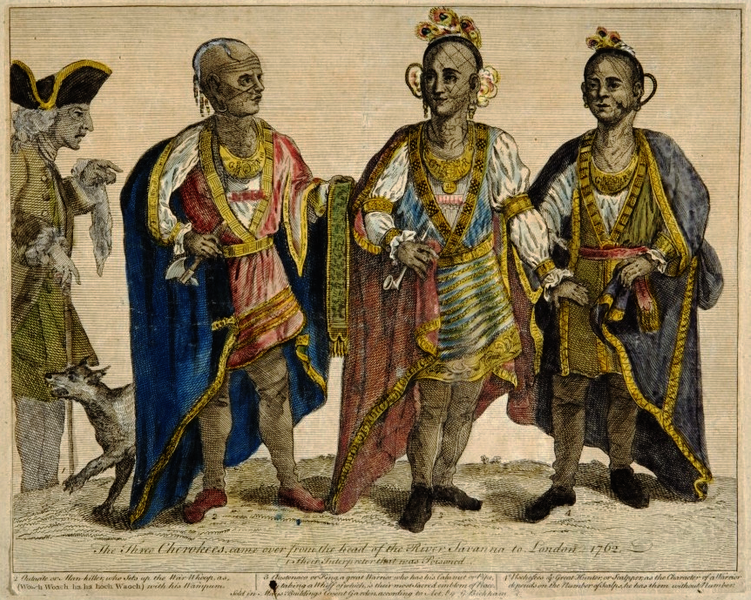
Ostenaco was born in the early 1700s as the youngest of 4 children and had one of the longest political careers of the Overhill headmen who were active during the Anglo-Cheroke War. He first appears in the historical record in 1741 and appears to have been from Tellico. According to Henry Timberlake, who spent several months with Ostenaco in 1762, Ostenaco was one of those rare men who combined distinction in both diplomacy and warfare; the other more famous leaders of his era, Attakullakulla and Oconostota, while active in both, were really only exceptionally skilled in one area. He won the “Man-Killer” title in his youth, and was also referred to as “Judd’s Friend” because of his friendship with a white man named Judd. During the Panic of 1751 and later when northern Indians encouraged Cherokee attacks on traders, Ostenaco raised forty-seven warriors to patrol the roads, protecting traders and defying anti-British factions among the Cherokees at Chota. He also gave pro-British talks among Lower, Middle, and Overhill towns, cementing his status as a friend of the British in general.1
By the early 1750s, he was one of the guardians appointed by Carolina agents to help the young “emperor” Amouskositte “rule.” (This political office was a fiction—Cherokee governance did not allow for monarchical or dictatorial rule but was instead centered on consensus governance. Installing one man as “emperor,” though, was a strategy that made sense to the British, and they tried to do so on several occasions in the first half of the 1700s.) By early spring 1753, Amouskositte’s public reputation was in ruins, particularly as rumors flew that he had tried to sell northern Cherokee hunting grounds to Virginia. In response, his former guardian Ostenaco withdrew his support from Tellico and strategically chose to move to Tomotley, near Chota, which under the leadership of Connecorte was increasingly prominent in Cherokee negotiations with South Carolina.2 Upon Connecorte’s death in 1760, Ostenaco was instrumental in getting Standing Turkey appointed Connecorte’s successor, though he seems to have been a fairly ineffective headman who fell out of power by 1765-1770.
In the years leading up to the Anglo-Cherokee War, Ostenaco gained a reputation of being a loyal ally to the British, confronting Attakullakulla several times in the early 1750s for suspected attempts to reach out to the French, a move Ostenaco believed was against Cherokee interests. Ostenaco also arranged–and perhaps participated in–a beating that left Attakullakulla severely injured and effectively halted his overtures to the French for several years. Trader Ludovic Grant Grant took a different interpretation of this beating, as he reported no knowledge of it having any political significance or roots, instead suggesting it was a drinking bout.3
By the early years of the Seven Year’s War, Ostenaco was in his early 50s and displayed both military and political leadership. He maintained his loyalty, and that of Overhill towns, in the tense year leading up to the war.4 However, once war did break out, Ostenaco was heavily involved in the siege of Fort Loudoun from March-August 1760, even leading it while Oconostota sought French aid.5 When the garrison surrendered on August 9, roughly two dozen of them were killed the next day, with especially brutal treatment reserved for the fort’s commander, Paul Demere. Some accounts of the massacre recount that when Demeré was dead, Ostenaco “rushed upon the field shouting, ‘Stop your hands, we have got the man we want!’” Others say Oconostota stepped in to prevent further violence.6 Cherokee victors captured nearly all the roughly one hundred fifty survivors and held them as prisoners during the following months of the war.
In the aftermath of Fort Loudoun’s surrender, Ostenaco seems to have been less eager to continue on attacks on colonial British settlements than some of his peers. John Stuart, one of the prisoners from Fort Loudoun, later recounted that at a general council on August 27, 1760, some Overhill headmen wanted to travel to Keowee, taking the guns from Fort Loudoun to aid in the attack on Fort Prince George. Ostenaco opposed this plan, seeming to fell that enough satisfaction had been fulfilled and declined to participate in any raids against Fort Prince George. The plan fell apart by September, when Attakullakulla spirited Stuart away to Virginia—the plan depended on Stuart’s knowledge of the fort’s cannons and cooperation in using them against other colonists.7 In September 1760, Oconostota and Ostenaco raised an English flag at Nequassee and sent peace talks to Bull, offering to exchange prisoners at Ninety-Six.
Ostenaco’s name does not feature as prominently in the actual peace negotiations as some of his peers, but he earned a coveted spot in the Cherokee delegation to London in 1762, accompanied by Lt. Henry Timberlake of Virginia. In his travels in Cherokee territory, Timberlake was pleased to to find that upon his explaining the treaty terms further to the Overhill Cherokees, Ostenaco gave a strict speech about how the Cherokees should strictly follow the peace articles, lest there be another war. He informed his fellow Cherokees that the British had the French and Spanish to worry about, and and “we enough of our own colour, without medling with another nation,” offering an interesting pro-peace argument along racial lines.8 Timberlake stayed at Chota for several months as Ostenaco’s personal guest before taking his host to Williamsburg and then on to London.
Ostenaco and his companions stayed in London from June-August 1762. Upon their arrival in Plymouth on June 16, Ostenaco, dressed and painted for the occasion, attracted a large crowd with his loud, solemn song giving thanks for the safe arrival. Timberlake tried to keep his Cherokee guests occupied with trips to the theater, cathedrals, gardens, historic sites like the Tower of London, and other entertainments. Ostenaco and his companions also enjoyed the pubs. On their second night at the Vauxhall Gardens tavern, the group left around two or three in the morning, and Ostenaco accidentally brushed against a man’s sword hilt, angering the man, who immediately drew his sword. The older man was unfazed, grabbing the blade in his bare hands and breaking it, to the astonishment of the crowd.9
On July 8, the Cherokees were finally able to meet George III. Ostenaco wore a blue mantle covered with lace, and the silver gorget engraved with the king’s arms. The other two Cherokee delegates wore red with gold lace and gorgets of plate. Colonel Archibald Montgomery, now Lord Eglinton, presented them at court, and Timberlake tried to serve as an interpreter for Ostenaco’s prepared speech. Ostenaco doubted Timberlake’s skill level, and Timberlake himself was uncertain how to translate the sections where the Cherokee praised him. The conversation lasted one and a half hours, and though the communication barrier hampered things somewhat, the Cherokees left with a favorable opinion of the king’s “affability and friendly nature,” as well as of his power, according to Timberlake.10
The delegation returned to South Carolina on August 25. Upon their return, Ostenaco gave William Bull a favorable account of his time in London, and the prepared speech that he had not been able to deliver as smoothly as planned to the king, asking that Bull send the text to the king to clear up any misunderstandings. In it, he promised no more bad talks, and the death of all Cherokees who killed the English. Ostenaco also returned with several pairs of spectacles, a novelty in Cherokee country. One of these pairs of glasses were found in excavations of Chota in 1969. To the end of his life, Ostenaco remained pro-British. Upon his arrival back in Chota, he met his new grandson named Richard, likely fathered by Henry Timberlake. Ostenaco died around 1780.11
- E. Raymond Evans, “Notable Persons in Cherokee History: Ostenaco,” The Journal of Cherokee History 1.1 (1976): 41-43. ↩︎
- E. Raymond Evans, “Notable Persons in Cherokee History: Ostenaco,” The Journal of Cherokee History 1.1 (1976): 43. ↩︎
- E. Raymond Evans, “Notable Persons in Cherokee History: Ostenaco,” The Journal of Cherokee History 1.1 (1976): 43-44; James C. Kelly, “Notable Persons in Cherokee History: Attakullakulla,” The Journal of Cherokee Studies 3.1 (1978): 9. ↩︎
- Ostenaco and Willinawa to William Henry Lyttelton, 2 March 1759, “William Henry Lyttelton Papers” (Clements Library, University of Michigan, Ann Arbor), correspondence box 10. ↩︎
- Louis M. Waddell, “Defending the Long Perimeter: Forts on the Pennsylvania, Maryland, and Virginia Frontier, 1755-1765,” Pennsylvania History 62.2. (1995): 178; James C. Kelly, “Oconostota,” The Journal of Cherokee Studies 3.4 (1978): 225. ↩︎
- E. Raymond Evans, “Notable Persons in Cherokee History: Ostenaco,” The Journal of Cherokee Studies 1.1(1976): 46; James C. Kelly, “Oconostota,” The Journal of Cherokee Studies 3.4 (1978): 225. ↩︎
- John Richard Alden, John Stuart and the Southern Colonial Frontier: A Study of Indian Relations, War, Trade, and Land Problems in the Southern Wilderness, 1754-1775 (Ann Arbor, MI: University of Michigan Press, 1944), 118-119; James C. Kelly, “Notable Persons in Cherokee History: Attakullakulla,” The Journal of Cherokee Studies 3.1 (1978): 20; James C. Kelly, “Oconostota,” The Journal of Cherokee Studies 3.4 (1978): 226. ↩︎
- Henry Timberlake, The Memoirs of Lt. Henry Timberlake: The Story of a Solider, Adventurer, and Emissary to the Cherokee, 1756-1765, edited by Duane H. King (Cherokee, NC: Museum of the Cherokee Indian Press, 2007), 18. ↩︎
- E. Raymond Evans, “Notable Persons in Cherokee History: Ostenaco” The Journal of Cherokee Studies 1.1 (1976): 49-50; Henry Timberlake, The Memoirs of Lt. Henry Timberlake: The Story of a Solider, Adventurer, and Emissary to the Cherokee, 1756-1765, edited by Duane H. King (Cherokee, NC: Museum of the Cherokee Indian Press, 2007), 58-63; Alden T. Vaughan, Transatlantic Encounters: American Indians in Britain, 1500-1776 (Cambridge: Cambridge University Press, 2006), 165, 172-174 ↩︎
- E. Raymond Evans, “Notable Persons in Cherokee History: Ostenaco” The Journal of Cherokee Studies 1.1 (1976): 51. ↩︎
- E. Raymond Evans, “Notable Persons in Cherokee History: Ostenaco” The Journal of Cherokee Studies 1.1 (1976): 51–53; Henry Timberlake, The Memoirs of Lt. Henry Timberlake: The Story of a Solider, Adventurer, and Emissary to the Cherokee, 1756-1765, edited by Duane H. King (Cherokee, NC: Museum of the Cherokee Indian Press, 2007), 69-72 ↩︎